World news and comment from the Guardian | guardian.co.uk |
- The prospect of travelling used to excite me. Now it evokes a moderate dread … | Ian Jack
- AFL grand final: Hawthorn jubilant after downing Fremantle Dockers
- Spirituality for children of a material world
- Java tragedy survivors claim Australian authorities ignored plight
- Bushfires threaten Sydney's northern beaches
- My hero: Kofi Awoonor by Nii Parkes
- Hawthorn v Fremantle: AFL grand final – as it happened
- At least 22 dead after asylum seekers' boat sinks off Java
- Analysis shows Hawthorn more likely to win grand final
- Barack Obama slams Republicans for threat to 'blow up entire economy'
- The best pictures of the day
- Italy's coalition on brink of collapse as politicians fail to agree fiscal deal
- Obama announces historic phone call with Rouhani
- New Jersey superior court judge orders state to allow same-sex marriage
- Obama holds historic phone call with Rouhani and hints at end to sanctions
- NSA employee spied on nine women without detection, internal memo shows
- Chris Froome on the world road championship and tragedy in Nairobi
- Halal Food Festival opens in London - video
- Letters: Greek universities' future under threat
- Letters: Women's role in war and peace
- Authorities 'cannot rule out' Samantha Lewthwaite played role in mall attack
- French watchdog barks at Google over missed deadline on privacy policy
- Britain accused of trying to impede EU data protection law
- Pakistan: kicking the can down the road | Editorial
- It's another bad week to be gay | Nancy Goldstein
| The prospect of travelling used to excite me. Now it evokes a moderate dread … | Ian Jack Posted: 28 Sep 2013 12:30 AM PDT  I used to make myself sick with excitement as a child at the prospect of a journey, but now there's one place to which I'm increasingly drawn I'm writing from the Crowne Plaza hotel in Electronics City, an address that Aldous Huxley might have invented for Brave New World but in fact is located in a Bangalore suburb. My room on the 10th floor overlooks a landscape where nothing is old. Any building built before 1990 should be treasured here as a historic monument. Offices, factories, flats and shopping malls, some tall and some squat, all of them square and light-coloured, stretch as far as the eye can see in every direction. The block closest to the hotel announces itself as the Salarpuria Infozone – another touch of yesterday's futurism. A mile-long stretch of elevated highway carries its traffic straight across the middle distance; nearer me, trees have been planted along the avenues that take the software workers to their offices. The sounds of parping and pip-pipping, muffled by the room's large but unopenable window, rise from the cars and scooters below. I arrived from an overnight flight only a few hours ago. I haven't been out. My only human contact since the check-in desk came when a hotel worker knocked on the door and asked if I had laundry. As for my room, it has all the luxuries – a walk-in shower as well as a bath, Wi-Fi, kettle, fridge, air-conditioning – that have become ordinary everywhere. As has the room's design: hard-edged black furniture echoes the wall-mounted widescreen, as though black was every traveller's favourite colour and the square their favourite shape. When I first came to India as a reporter, such a room would have been inconceivable. Only the newest and smartest hotels were air-conditioned enough to do without ceiling fans; usually you typed at your portable underneath the swish-swish of the turning blades, answering the door to a bothersome procession of would-be tea-bringers and shoe-shiners who quite rightly saw you as a better source of cash than the biscuit salesman down the corridor. I loved travelling then, particularly in India where the job of reporter allows you to turn up in obscure towns, see something new, and meet friendly people anxious to satisfy your curiosity. That you might have to stay overnight in a railway retiring room or a nearly abandoned indigo planters' club only added to the sense of adventure. As a child, probably typically, I could find the prospect of a journey so exciting that once or twice I made myself ill thinking about it. In the summer before I went up to secondary school, my father announced that he and I would take the family tandem and cycle along Hadrian's wall – in fact, on the road to the south of it – as a reward for passing the exam. I didn't sleep at all the night before we took three trains (the tandem in the guard's van) to a station on a long-since uprooted Northumbrian branch line, where we put up in a country hotel. My nervy sleeplessness must have heightened my senses that day because I can remember something about every hour in it. The types of locomotive at the head of our trains, of course; the sight of the Tyne's swing bridge opening to let a tug through, of course; but beyond these devotional objects I remember the dining room of the George hotel, Chollerford – the starched white tablecloths, the couples who had just stepped out of their Austins and Rovers – and our about-turn at the entrance when my father saw it was no longer the easy-going, rustic place he remembered as a touring cyclist in the 1920s. "You can have some tea and biscuits in your room instead, sir, if you'd like," said the waiter, and he agreed that we would. Only later did I understand how disappointed and angry he'd felt that money and cars had spoiled a place he remembered fondly from his youth, and that he'd wanted to relive this earlier pleasure with me, as parents often do. Now, looking out over a city that in the 1970s had fewer than two million people and now contains 9.6 million, the idea that the George exemplified change for the worse is ridiculous. When I first saw Bangalore it was an intimate city with lots of trees and by Indian standards a cool climate, which endeared it to the retirees who came to live in its bungalows. "You'll like it," I told my children before we came eight years ago, but instead they hated it, their first experience of India an overwhelming jumble of diesel fumes, engine noise and dust. Everything had changed, even the climate (hotter and dryer), and has gone on changing. The long road from the airport, opened in 2008, has the biggest hoardings I've ever seen, towering above the roadside signs for the traditional staples, such as cement and electric fans, to advertise the high flats rising on the land behind them: "The address of the future" and "Homes that speak for the good life". In their recent book on the problems of modern India, An Uncertain Glory, the economists Jean Drèze and Amartya Sen write that uneven growth makes the country "look more and more like islands of California in a sea of sub-Saharan Africa". The dual carriageway into town is a good place to get a sense of what they mean. Of course, I wondered why I'd come. The prospect of travelling, which used to excite me so much, now often evokes a moderate dread. Why and when this happened is hard to know. When I began to wear DVT socks for long-haul flights? When flying began to seem morally reprehensible unless for urgent or serious purposes? Or when terrorism made it too complicated and frightening? I don't think any of those. When the subjects of popular Q&A interviews are asked if death scares them, they tend to say no, not the being dead but yes, the act of dying. And so it is with travel. Neither being there nor getting there is the fundamental problem, even when it takes half an hour to get through security and you need to remove your belt, your shoes and your hat; even when, at six in the morning, you find yourself on an unfamiliar airport road looking up at property adverts that are the size of several houses. The problem, I think, has to do with leaving home, a place that increasingly has so much to recommend it. "You'll be fine once you get there," says my wife, and while I know this is true I'm surprised to find that she thinks it needs stating – to me, who has seen shots fired in anger, swum the Crocodile river, and so forth. Why does she mistake me for a forgetful party in an old-fashioned sitcom, with a wife who straightens his tie and hands him his briefcase at the door? Could it be because I so frequently say "I don't know why I'm going" but nonetheless go? And, naturally, I know why I'm here. The Crowne Plaza in Electronics City is, oddly enough, the venue for the Bangalore literary festival at which I'm a guest. Quite soon I'll be meeting some old friends and perhaps even making some new ones. The alienation and melancholy that comes after a sleepless night on a plane and a day alone in a hotel room will gradually dissipate. By the time the weekend's over, I'm sure I'll find virtue even in the view (already I've noticed a lake). theguardian.com © 2013 Guardian News and Media Limited or its affiliated companies. All rights reserved. | Use of this content is subject to our Terms & Conditions | More Feeds       |
| AFL grand final: Hawthorn jubilant after downing Fremantle Dockers Posted: 28 Sep 2013 12:23 AM PDT  • Hawks defeat Dockers 11.11 (77) to 8.14 (62) Hawthorn have held off a Fremantle comeback to clinch their second AFL premiership in six years. The Hawks won 11.11 (77) to 8.14 (62) in front of 100,007 fans. Brian Lake – who also won the Norm Smith medal for his performance – starred in defence, to more than justify his recruitment from the Western Bulldogs last off-season, captain Luke Hodge again showed himself one of the AFL's great big-game performers and Jack Gunston followed his preliminary final heroics with another four-goal haul. It delivered Hawthorn their first flag since 2008 – making two-time premiership players of 10 members of Saturday's side, including Shaun Burgoyne, who won a flag with Port Adelaide in 2004. One of those is Lance Franklin, who was again quiet with one goal in what might have been his last game in Hawthorn colours, as he considers a big-money move to Greater Western Sydney. It also ensured the Hawks would shake the underachievers tag, after near misses in the past two years – upset by 10 points by Sydney in last year's grand final and falling three points short of Collingwood in a preliminary final in 2011. It's another grand final defeat for Dockers coach Ross Lyon, who led St Kilda to the 2009-10 deciders for two losses and a draw, with Fremantle's former Saints defender Zac Dawson sharing Lyon's record of four grand finals without a win. theguardian.com © 2013 Guardian News and Media Limited or its affiliated companies. All rights reserved. | Use of this content is subject to our Terms & Conditions | More Feeds       |
| Spirituality for children of a material world Posted: 28 Sep 2013 12:00 AM PDT  Anna Maxted worries that her sons' lack of spiritual education means they won't develop a sense of the sacred One of the oldest churches in Britain – St Andrews in Greensted, Essex – is a tiny, beautiful, higgledy-piggledy oak building surrounded by verdant lawns, and witness to 1,300 years of joy, sadness and hope. I was bursting to convey how special it was to my boys. "Imagine, lads: this was here when William the Conqueror was in charge – and look, a Crusader's grave; they think he was a bowman." Quiet solemnity? Young heads bowed in sombre appreciation? Inexplicably, after a two-hour car journey, the little heathens just mucked around. Despite the fact that Caspar is six (a tad young for saintliness, admittedly), I began to fret. My children were devoid of spirituality! It was my fault. We are a secular household – kind, loving, yes, yes – but firmly focused on facts, science and sport. A bit of contemplation, awareness and, if you please, humility – that was what I was after. Attending the barmitzvah of a friend's son recently, stoked my concern. Her boy's sweet voice soared and echoed, the sun streamed through the synagogue's stained glass windows bathing us in rainbows of warmth, and the father and grandfather proudly huddled close to the singer. I was struck by a sense of profundity, of being a tiny part of a great sweep of history and humanity. I dabbed at my eyes with my shirt cuff and wondered if, by forsaking the godly path, I'd banished my own offspring to a fog of unknowing. In the 70s, children were exposed to religion, whether we liked it or not. My husband kicked along in the Cub scouts' church parade, and I, as a Brownie, promised to do my duty to God and the Queen. We fidgeted through preachy assemblies at school and sang hard-line hymns. I was made to attend Hebrew classes, and synagogue on high holy days. Aged nine, I found it all a bore and was disrespectful. When, on Rosh Hashanah, they blew the Shofar – the sombre tones of which are supposed to rouse the congregation to repentance and inspire us to re-commit to God – I started to laugh and had to run from the hall. Still, from the happy distance of three decades, I maintain that being subjected to the grandeur of religious ceremony – or indeed, being shut in an airless room on Sunday mornings and being forced to learn endless passages of the Bible, Torah or Qur'an by rote – is good for the soul. I was eventually spat out with a little knowledge and understanding of my cultural history, and a sense of perspective, a respect for other faiths, and the notion that it wasn't all about me. But in 2013, RE at primary school seems all very brief and academic. I'm sure Judaism was dispensed with in a couple of days. Meanwhile, when we visit my mother for Passover, and engage the boys with plagues of locusts, they fret about how much trifle they'll be allowed for dessert, and their kippot slide off their heads. Any religious event is delicately wrought with friction, as my mother tries to convey a sense of gravitas to a tough crowd. Last year, when she lit the Hanukah candles, the youngest affected to huff them out as if on a birthday cake – a jape poorly received. At times like these, I feel my offspring's irrepressible joy needs repressing. "I want them to have respect," I growled to my husband, as we bustled them out of my mother's house, hot with mortification. "For something, for anything!" Of course, they do – when the eight-year-old bumped into Ray Davies at the seaside and got to shake hands with the singer and composer of Waterloo Sunset, he pronounced it "one of the 10 most exciting moments of my life!" But it seems that they decide. I should add: my kids love animals, are sensitive to other people's pain, and love nothing better than communing with nature, in shorts, when it's one degree above freezing, and yet, outrageously, I am demanding more. I feel that they need a sense of the sacred to – in the nicest possible way – combat the materialism and ego of modern life. I don't claim that religious equals goodly – heavens, no! But it does prompt thought about life, eternity, the planet. If its influence is declining, do we gain our spirituality from love? And is that enough? Possibly not, according to the Rev Canon Professor Leslie Francis – he believes religion has the edge. "In a sense, religion, spirituality, and character are very different concepts, but as a psychologist, I can see that in young people, those three things are correlated. Religion offers a kind of meta-narrative of what life is about, and a certain set of expectations about how individuals respond to opportunities and challenges in life." He regards spirituality as relational, concerning a person's "relationship with self, with other people, their environment … and the transcendent, [or] at least a recognition that there might be some ultimate value or criteria against which transitory things can be judged." He adds that while there are other meta-narratives that can lead to a spiritual overview, "religion has been in business long enough to know something about what it's doing." Perhaps what I'm blundering towards then, is not necessarily related to faith, but to that element of character inspired by the non-material – and I hope my children have this; but I suspect it's an ethereal quality, glimpsed when the conditions are right, like a rainbow. As it happens, our education system addresses spirituality as a non-religious concept, and character is key. The British Humanist Association directs me to Ofsted guidelines that detail a school's duty to further children's "spiritual, moral, social and cultural development", which are actually rather poetic: "Some people may call it the development of a pupil's soul, others may call it the development of personality or character." Also rooting for character is the philosopher and psychologist William James, who saw spirituality as independent of any specific faith. Psychologist Dr Stephanie Thornton – author of Understanding Human Development and a Catholic sceptic – says: "James would put every value that you have – like not poking someone's eye out – in the spiritual domain. In so far as your sons, and other children, have got those values, they are spiritual values." It's a promising start. And it gets better. Dr Thornton cites Carl Jung, for whom spirituality incorporated values, but was also linked to a sense of "the numinous" – the sacred, almost magical. While you can't force wonder, Dr Thornton believes there are all sorts of everyday things with a dimension that is reverential and from which a respect arrives – and you can prime children to react. "A friend used to run a nursery," she says, "and they owned a piece of woodland. Every year, she took the children out there to camp. Round the fire, on the first night, in the darkness, she'd tell them about the pixies, elves and fairies that lived in the woods. And that if they walked in a crocodile, about five feet apart, very quietly through the wood, they would see the pixies. And they all did. They saw them. "And after that these children had that sense of the numinous, about that woodland. It became a sacred grove. I totally approve. I think it gives a sacred dimension to reality that is not there in the prosaic, materialistic sense, and [is not dependant on] whether you believe God is going to come down and smite you or rescue you." At last, I see it. I see it in my children's awe, caught last summer in a fantastically biblical thunderstorm on the beach. I see it in their tenderness towards our old cat. And I see it when they discuss how they miss their beloved great-uncle, who used to let them ride up and down the stairs on his chairlift. "How old was he?" asks the little one. "Ninety-two," I reply. "No he's not," says the eight-year-old. "Now he's zero, because he's in heaven and he's just started." I suddenly feel rather foolish, and stop fretting. theguardian.com © 2013 Guardian News and Media Limited or its affiliated companies. All rights reserved. | Use of this content is subject to our Terms & Conditions | More Feeds       |
| Java tragedy survivors claim Australian authorities ignored plight Posted: 27 Sep 2013 11:45 PM PDT  Up to 70 feared dead after boat with asylum seekers on board sinks off Java Survivors of a boat that sank off Java claim the Australian embassy ignored a distress call. Twenty-two asylum seekers have been confirmed as drowned but authorities in Indonesia fear that number may rise to more than 70. "I called the Australian embassy; for 24 hours we were calling them. They told us just send us the position on GPS, where are you," one survivor, Abdullah, a man from Jordan, was reported as saying by Fairfax media. "We did, and they told us, 'OK, we know … where you are'. And they said, 'We'll come for you in two hours'. "And we wait two hours; we wait 24 hours, and we kept calling them, 'we don't have food, we don't have water for three days, we have children, just rescue us'. And nobody come. Sixty person dead now because of Australian government." One of the passengers, a Lebanese man, had reportedly lost his pregnant wife and eight children in the disaster. Just 25 of those aboard had been rescued before efforts to locate survivors were postponed on Friday evening due to failing light. It's believed to be the first fatal attempted asylum-seeker crossing under the Abbott government, and comes after another group of 44 asylum seekers were rescued by an Australian navy vessel in the Sunda Strait on Thursday. The boat that sank on Friday had departed from the fishing village of Pelabuhan Ratu, in the Sukabumi regency, on the south coast of western Java. It first got into trouble about 10 hours into its journey and efforts were made to return to Indonesia before it sank. A police official from the district of Cianjur in Java said authorities were alerted to the incident after bodies were discovered floating in an estuary on Friday morning. "We have now found 22 dead bodies, most of them are children as they cannot swim," the official said, according to news agency AFP. He said the boat had broken into several pieces. A spokesman for the Indonesian search and rescue agency, Basarnas, said his office was not advised of an incident involving an asylum seeker boat until 3pm local time on Friday. He said the Australian Maritime and Safety Authority had contacted Basarnas about the boat. The latest tragedy in waters between Indonesia and Australia comes amid a ramping up in tensions between Canberra and Jakarta over the asylum seeker issue, and days ahead of talks in Jakarta between Tony Abbott, and the Indonesian president, Susilo Bambang Yudhoyono. Abbott and Yudhoyno will meet on Monday, with asylum seeker policy expected to be at the top of the agenda. Strong waves are preventing Indonesian rescuers from continuing the search for survivors on Saturday morning. "The waves are just too high for our speed boats to go out yet. They're four to six metres. We hope conditions improve soon," Warsono, a police official in Cianjur district on Java, told AFP, adding no helicopter had been deployed. theguardian.com © 2013 Guardian News and Media Limited or its affiliated companies. All rights reserved. | Use of this content is subject to our Terms & Conditions | More Feeds       |
| Bushfires threaten Sydney's northern beaches Posted: 27 Sep 2013 11:17 PM PDT  High temperatures have led to fires breaking out across New South Wales A bushfire has broken out on Sydney's northern beaches, cutting access to an iconic lighthouse. Rural Fire Service inspector Ben Shepherd said the fire was burning at Barrenjoey headland at Palm Beach – where the soap opera Home and Away is filmed – and had cut an access trail to Barrenjoey lighthouse. An emergency alert is expected to be issued to people in the area. "We are about to send an emergency alert to people in that area to say 'shelter at the lighthouse do not try to go back down the access trail itself'," he said on Saturday afternoon. Firefighters and aircraft are on scene, the RFS says. Barrenjoey lighthouse sits at Sydney's most northern point and is about 1km from Palm Beach, according to National Parks' website. Meanwhile, firefighters are working to contain a bushfire on the NSW mid north coast that has been threatening properties. A watch and act alert has been issued for the blaze, which is burning near Port Stephens at Italia Road, East Seaham. Shepherd said the fire crews had managed to defend properties in the area. "We have see some property come under threat, but crews have been able to save a couple of homes in the area," he told Fairfax Radio Network. He said the fire "was making its way further up the coast towards firegrounds at the Great Lakes and Taree". On its website, the RFS said the immediate fire threat to properties in the area had eased. Other major fires continue to burn in the Taree and Great Lakes area on the mid north coast. Total fire bans remain in place for Greater Sydney, Greater Hunter, North Coast, New England and Northern Slopes regions. Hundreds of firefighters are out battling fires as much of the state experiences hot temperatures and gusty winds. An eye-witness to the Palm Beach fire, Scott Carpenter, said it looked like "an inferno" was engulfing the headland. "I'm watching in horror," he told AAP via phone. "The whole east side of the headland is in flames ... it's spreading very quickly." He said helicopters were currently dropping water around historic buildings and the lighthouse. It looked like the lighthouse was "likely to be isolated" by the blaze, he said. theguardian.com © 2013 Guardian News and Media Limited or its affiliated companies. All rights reserved. | Use of this content is subject to our Terms & Conditions | More Feeds       |
| My hero: Kofi Awoonor by Nii Parkes Posted: 27 Sep 2013 11:09 PM PDT  The death of my uncle Kofi Awoonor in the Westgate mall attack was a profound personal loss, but his literary legacy will live on I was 14 when I first read Kofi Awoonor's novel, This Earth, My Brother. Its wonderfully musical prose, its immersion in Accra's history, its obvious confidence in its place in the world, made me go to my father and ask about the other uncle. I grew up with two writer uncles, Frank Kobina Parkes and Kofi Nyidevu Awoonor. Both were devotees of Kwame Nkrumah, Ghana's first president, yet never let politics affect their personal relationships. I should know; my mother is the niece of General Ankrah – the man installed as leader when Nkrumah was overthrown. Such contradictions are the stuff great stories are made of. The St Lucian poet Derek Walcott once wrote that tension creates memory and I suspect that is why I have always held Uncle Frank and Uncle Kofi so dear. Yet, I would add to Walcott's assertion my own; absence creates myth. Frank was a treasured uncle; Kofi was a mythical one. It is almost not strange that a band of terrorists who have created their own mythical code in service to their perception of the message of the absent prophet Muhammad (peace be upon him), were responsible for his departure. The afternoon of 18 September 2013 at the Nairobi National Museum was my first meeting with Uncle Kofi. At the end of the Storymoja festival press conference, he hugged me: "Your father used to crack me up. I have stories to tell you." Three days later, I was waiting at the festival to do a poetry reading alongside him – he never turned up. Close to midnight, the Ghana high commissioner in Kenya called to confirm that he had been killed in the Westgate mall attack. My feeling of personal loss is profound, but, as a literary hero, Kofi Awoonor lives on. Absent heroes are powerful because their legacy is not influenced by them, we are drawn to the elements that resonate and that, ultimately, serve both hero and devotee best. Professor sleep well, we will meet on the other bank of the river. theguardian.com © 2013 Guardian News and Media Limited or its affiliated companies. All rights reserved. | Use of this content is subject to our Terms & Conditions | More Feeds       |
| Hawthorn v Fremantle: AFL grand final – as it happened Posted: 27 Sep 2013 07:33 PM PDT Minute-by-minute report: Hawthorn got off to a brilliant start and held on for victory despite a late rally from Fremantle       |
| At least 22 dead after asylum seekers' boat sinks off Java Posted: 27 Sep 2013 05:51 PM PDT  Indonesian authorities fear for 70 people still missing after boat carrying about 120 sank on its way to Australia Indonesian authorities hold grave fears for up to 70 asylum seekers still missing, feared drowned, after their boat sank en route to Australia. At least 22 people, mostly children, drowned when the boat, which was carrying about 120 passengers, sank in rough seas on Friday off the coast of Java. One of the passengers, a Lebanese man, had reportedly lost his pregnant wife and eight children in the disaster. Just 25 of those aboard had been rescued before efforts to locate survivors were postponed on Friday evening due to failing light. The search was expected to resume on Saturday. It's believed to be the first fatal attempted asylum-seeker crossing since the Abbott government took power, and comes after another group of 44 asylum seekers were rescued by an Australian navy vessel in the Sunda Strait on Thursday. The boat that sank on Friday had departed from the fishing village of Pelabuhan Ratu, in the Sukabumi regency, on the south coast of western Java. It first got into trouble about 10 hours into its journey and efforts were made to return to Indonesia before it sank. A police official from the district of Cianjur in Java said authorities were alerted to the incident after bodies were discovered floating in an estuary on Friday morning. "We have now found 22 dead bodies, most of them are children as they cannot swim," the official said, according to news agency AFP. He said the boat had broken into several pieces. A spokesman for the Indonesian search and rescue agency, BASARNAS, said his office was not advised of an incident involving an asylum seeker boat until 3pm local time on Friday. He said the Australian Maritime and Safety Authority had contacted BASARNAS about the boat. The latest tragedy in waters between Indonesia and Australia comes amid a ramping up in tensions between Canberra and Jakarta over the asylum seeker issue, and days ahead of talks in Jakarta between Prime Minister Tony Abbott and Indonesian President Susilo Bambang Yudhoyono. Abbott and President Yudhoyno will meet on Monday, with asylum seeker policy expected to be at the top of the agenda. theguardian.com © 2013 Guardian News and Media Limited or its affiliated companies. All rights reserved. | Use of this content is subject to our Terms & Conditions | More Feeds       |
| Analysis shows Hawthorn more likely to win grand final Posted: 27 Sep 2013 04:17 PM PDT  Number crunching suggests Hawthorn's attacking attributes will overcome Fremantle's strong defence Hawthorn are most likely to win the AFL grand final based on a statistical analysis* of their performance in the season so far. This isn't surprising, given their No 1 position on the ladder, but please indulge me for a spot of number crunching. Using the AFL's statistics here and here, I've analysed various match attributes for how well they correlate with the number of wins for each team. Taking the average kicks, handballs, disposals, marks, hit-outs, frees for, frees against, tackles, goals, behinds and points against for each team, I tested each for correlation with the number of wins per team to get a crude indication of how each attribute relates to winning games. Here are the results: Only goals, disposals, kicks, behinds and points against were statistically significant with a p value of less than 0.05, and were all correlated quite strongly with wins. The closer the R value is to 1 or -1, the stronger the relationship between wins and the other variables is. Goals and behinds aren't a surprise, of course; if you score more goals obviously you're more likely to win. Kicks and disposals are a measure of possession. Points against has a big contribution on the defensive side of things, though it is interesting that defensive statistics like tackles and marks aren't as important as attacking statistics. This may not bode well for Fremantle, who are the stronger defensive team. Fremantle have the lowest total points conceded in 2013, with higher average tackles and marks per game than Hawthorn. Hawthorn however dominate in the attacking statistics with higher goals, behinds and disposals. Taking the five attributes with significant correlations, I then used a linear regression analysis to get a model of how the number of wins varies with changes in goals, disposals, kicks, behinds and points against. The results of the regression were statistically significant, with an R value of 0.9, indicating most of the variation in the number of wins was "explained" by those five factors. The formula for determining the number of wins was: Games won = 2.7032 - 0.0541 * Kicks avg + 0.0300 * Disposals avg + 1.4243 * Goals avg + 0.2214 * Behinds avg - 0.0064 * Points against Which had an R2 value of 0.87, indicating the linear model was a pretty good fit. So this gives us a formula for working out what each teams success rate should be given their average in each of these stats. Plugging in each team's season results gives a predicted wins value of 17.17 for Hawthorn, which is less than their actual final number of 19 wins from 22 games, and a value of 14.02 for Fremantle, which is less than their actual result of 16. The difference between the real and predicted results is greatest for Fremantle, but not by a lot. So either this model is complete rubbish (possible) or Fremantle have been winning more games than they should have, and are also right to be lower placed than Hawthorn as an attacking team trumps a defensive team. Based on this I'm picking Hawthorn for the win. All of that said, it's still a game of footy and anything could happen on the day! *The usual disclaimer: I've only ever done statistics as an undergraduate science student, so this isn't the most rigorous or even correct way to do things. Just a bit of fun, but I'd be interested to hear from anyone out there who has a proper maths background and an interest in sport. theguardian.com © 2013 Guardian News and Media Limited or its affiliated companies. All rights reserved. | Use of this content is subject to our Terms & Conditions | More Feeds       |
| Barack Obama slams Republicans for threat to 'blow up entire economy' Posted: 27 Sep 2013 03:34 PM PDT  President stands firm in confrontation over Obamacare and debt ceiling as government prepares for looming shutdown President Barack Obama on Friday issued a stark warning over the consequences of the continued stalemate in Congress over funding the federal government, saying US troops face disruption to their pay in the event of a shutdown and castigating his opponents for threatening to "blow up the entire economy". The president took to the podium for the second time in as many days, to issue his most withering attack yet on House Republicans who will spend this weekend deciding whether to attach new demands to stalled federal spending authorisation. Obama said he was willing to negotiate over government spending, but would not give in to a laundry list of other demands from Republicans who want to repeal his signature healthcare law and advance other "pet projects" they have otherwise failed to pass. "We're not going to do this under the threat of blowing up the entire economy," Obama said. The president warned of drastic economic consequences if the shutdown was forced through. "It would throw a wrench into the gears of our economy at a time when those gears have gained some traction," the president said, claiming that even the threat of a shutdown was already "probably having a dampening effect on our economy". In fact, economists believe that a shutdown will have less impact on the economy than the looming fight over the debt ceiling. The row over raising the government's $16.7tn borrowing limit is much more serious than tussles over the federal government's spending authority. The treasury secretary, Jack Lew, warned Congress this week that unless it approves an increase in the borrowing limit imminently, the US government will be unable to meet its bills by 17 October. "Even if Congress can reach an agreement to renew the federal government's spending authority before it expires this Monday – which is looking increasingly unlikely – there's a much more serious battle brewing over the push to raise the debt ceiling before the Treasury runs out of money sometime shortly after 17 October," Capital Economics pair Paul Ashworth and Paul Dales wrote to clients on Friday. The Bureau of Labor Statistics will release its latest jobs report next Friday and important manufacturing data will also be released next week. In both cases, economists expect the figures to underline the strengthening US economy. But PNC bank senior macroeconomist Gus Faucher said a failure to raise the debt ceiling would "all but wipe out" that recovery. "There will be an immediate drag on the economy, interest rates will rise for everyone. Social security, federal wages and contracts will not get paid. It would be disastrous," he said. "The economy would basically stall." On Friday, Obama showed no sign of backing down in his standoff with House Republicans, insisting that the Affordable Care Act – the healthcare reform, known as Obamacare, that has prompted this latest budget showdown – would continue regardless of what happens on Capitol Hill. "On Tuesday, about 40 million more Americans will be able to finally buy quality, affordable healthcare, just like anybody else," he said. "Those marketplaces will be open for business on Tuesday no matter what – even if there's a government shutdown. That's a done deal." Earlier, the Senate set up a clash with House Republicans when it passed a spending authorisation bill that stripped out a clause allowing for the defunding of Obamacare. Obama welcomed the bipartisan deal in the Senate, and appealed directly to lawmakers by spelling out the personal consequences of once again trying to force him to back down over the reform. "To any Republican in Congress who is currently watching, I'd encourage you to think about who you're hurting," he said. "There are probably young people in your office right now who came here to work for you, without much pay, because they believed that public service was noble. You're preparing to send them home without a paycheck." More than a third of federal workers would be told to stay home if the government shuts down, forcing the closure of national parks from California to Maine and all the Smithsonian museums. Low-to-moderate income borrowers and first-time homebuyers seeking government-backed mortgages could face delays. Supervisors at government agencies began meetings on Thursday, to decide which employees would continue to report to work and which would be considered nonessential and told to stay home under contingency plans ordered by the Office of Management and Budget, or OMB. "Fifty percent of our members may be locked out of work altogether during this shutdown," said David Cox, president of the American Federation of Government Employees. "Half will be expected to continue to work without a paycheck." Employees who are deemed essential and keep working will not be paid during any shutdown. Once Congress has approved new funding, they will receive retroactive pay. Not all government would cease to operate. Services considered critical to national security, safety and health would go on as usual – such as border patrol, law enforcement and emergency and disaster assistance. Social Security and Medicare benefits would keep coming, but there would likely be delays in processing new disability applications. Active-duty military personnel are exempt from furloughs, as are employees of the US Postal Service, which doesn't depend on annual appropriations from Congress. But Obama said troops could face delays to their paychecks. "If the government shuts down on Tuesday, military personnel – including those risking their lives overseas for us right now – will not get paid on time," the president said. For the administration, the best-case scenario this weekend is that House Republicans choose to drop their fight over spending authorisation but mount a separate showdown over extending the government debt limit in mid-October. Obama warned this path, which could lead to the government defaulting on its debt, would be even worse. "Failure to meet this responsibility would be far more dangerous than a government shutdown," he said. "It would effectively be an economic shutdown, with impacts not just here but around the world." The Associated Press contributed to this report. theguardian.com © 2013 Guardian News and Media Limited or its affiliated companies. All rights reserved. | Use of this content is subject to our Terms & Conditions | More Feeds       |
| Posted: 27 Sep 2013 03:22 PM PDT The Guardian's photo team brings you the best from the world of photography today       |
| Italy's coalition on brink of collapse as politicians fail to agree fiscal deal Posted: 27 Sep 2013 03:00 PM PDT  Failure to agree on €3bn of budget measures underlines breakdown between Democratic party and People of Freedom Italian prime minister Enrico Letta failed to secure backing for a vital package of fiscal measures on Friday as divisions with centre-right partners in his fragile coalition took the government to the brink of collapse. Letta flew back from a visit to New York with coalition unity already in tatters after a threat by centre-right politicians to walk out over Silvio Berlusconi's battle against a conviction for tax fraud. After two days of mounting tension and with financial markets on edge, he met ministers late on Friday in a last-ditch attempt to avert a rise in sales tax and secure approval for additional budget measures needed to bring Italy's deficit within European Union limits. However, with the meeting still in progress, officials made clear that no deal could be reached. "The conditions aren't in place at the moment," said one official. Letta is now expected to go before parliament next week to seek support to continue in office. Failure to agree on €3bn of budget measures, demanded by both Letta's centre-left Democratic party (PD) and Berlusconi's People of Freedom (PDL), underlined the breakdown between the two traditional rivals, which were forced together by last February's deadlocked election. Economy minister Fabrizio Saccomanni, who has staked his credibility on meeting the EU budget limits and faced constant sniping from the PDL over recent months, was furious at the breakdown, officials said. PDL politicans said proposals to avert the one percentage point rise in sales tax, scheduled to take effect in October, would have been funded by an increase in fuel taxes which would have punished consumers. With the sales tax rise, passed by the previous government led by Mario Monti, due to kick in on Tuesday, prospects for a deal appear remote. "We can't accept the blame for this," PDL secretary Angelino Alfano, who is also deputy prime minister, told the cabinet, according to one official. "We can't stay in the government if taxes are going up and there are no cuts to spending," he said. Letta's left-right coalition has flirted with collapse ever since Italy's top court convicted former premier Berlusconi of tax fraud last month and sentenced him to four years in prison, commuted to a year of house arrest or community service. On Wednesday, PDL politicians said they would resign en masse if a Senate committee meeting on 4 October votes to begin proceedings to expel their leader from parliament. On returning to Italy on Friday after courting foreign investors in New York, Letta met President Giorgio Napolitano who, if the government fell, would have to either call new elections or try to oversee the creation of a new coalition. A spokesman for the president's office said the head of state, who has repeatedly said he does not want a return to the polls, had given Letta his full support to seek the backing of cabinet and parliament. If Letta, who has a commanding majority in the lower house, can secure the backing of a few dozensenators among PDL rebels or opposition parties including the anti-establishment 5-Star Movement, he could form a new coalition. The political convulsions in the eurozone's third largest economy have increasingly worried investors, although with the European Central Bank guaranteeing stability in the markets, there has been none of the panic seen during previous crises. At an auction of 10-year bonds on Friday, Italy's borrowing costs rose to their highest level in three months, while the premium investors demand to hold Italian debt rather than AAA-rated German paper widened to 267 basis points from under 250 at the start of the week. theguardian.com © 2013 Guardian News and Media Limited or its affiliated companies. All rights reserved. | Use of this content is subject to our Terms & Conditions | More Feeds       |
| Obama announces historic phone call with Rouhani Posted: 27 Sep 2013 02:52 PM PDT Call with Iranian president is first direct contact between leaders of the two nations since 1979       |
| New Jersey superior court judge orders state to allow same-sex marriage Posted: 27 Sep 2013 02:25 PM PDT  The judge says the state is unconstitutionally blocking couples from receiving federal benefits by only permitting civil unions New Jersey has been ordered to allow same-sex marriages after a judge ruled that its system of civil unions violated the state's constitution. Judge Mary Jacobson issued the order on Friday after a long-running litigation brought by gay couples against the state. The ruling means same sex couples will be able to marry from 21 October in New Jersey. "These couples are now denied benefits solely as a result of the label placed upon them by the state," Jacobson wrote in a 53-page opinion explaining her decision. She said civil unions did not carry the same weight as marriage because they were not recognised at federal level. The state attorney general's office, which has defended the lawsuit, must now decide whether to appeal against Jacobson's ruling and ask for a stay. If the judge's ruling stands New Jersey would become the 14th state to permit gay marriage. The case is one of the first examples of how the supreme court's decision in June to invalidate the federal law defining marriage as being between a man and a woman has altered the legal landscape for gay marriage advocates. In Friday's ruling, Jacobson accepted the argument of gay couples that the state is blocking citizens from receiving federal benefits because it refuses to allow same-sex couples to marry. The supreme court ruled in June that the Defence of Marriage Act was unconstitutional, effectively extending federal benefits to married same-sex couples. Jacobson's ruling said that because those couples could not marry in New Jersey they were being discriminated against, in violation of the state constitution's equal protection requirements. New Jersey's top court ruled in 2006 that gay couples had to have the same legal rights as married couples. Same-sex couples in New Jersey presently can enter into civil unions. New Jersey governor Chris Christie is opposed to gay marriage, but his administration has not said yet whether it will appeal. Christie vetoed a bill that would have legalised gay marriage in 2012 but finds himself in a tricky position as a Republican governor in an overwhelmingly Democratic state. A Quinnipiac poll in July found that New Jersey voters support same-sex marriage by 60 to 31%. Christie is said to be eyeing a run for president in 2016, however, and having recently overseen the passage of same-sex marriage into law would not be seen favourably among the ultra-conservative primary voters. The Associated Press contributed to this report theguardian.com © 2013 Guardian News and Media Limited or its affiliated companies. All rights reserved. | Use of this content is subject to our Terms & Conditions | More Feeds  |
| Obama holds historic phone call with Rouhani and hints at end to sanctions Posted: 27 Sep 2013 02:14 PM PDT  President says discussion with Iranian counterpart showed 'basis for resolution' of dispute over Tehran's nuclear programme Barack Obama and Hassan Rouhani held the first direct talks between American and Iranian leaders since the 1979 Islamic revolution, exchanging pleasantries in a 15-minute telephone call on Friday that raised the prospect of relief for Tehran from crippling economic sanctions. Speaking at the White House shortly after the historic call, Obama said his discussion with Rouhani had shown the "basis for resolution" of the dispute over Iran nuclear programme. The conversation, in which Obama communicated his "deep respect for the Iranian people", capped a week of diplomatic breakthroughs. Rouhani ended a five-day visit to New York for the UN general assembly with a striking offer to work rapidly to defuse tensions with America, and hailed the US as "a great nation" – a dramatic shift in tone for an Iranian leader. Both leaders expressed confidence their countries could reach a peaceful settlement to their standoff over Iranian nuclear programme. Obama, in his White House statement, said: "While there will be significant obstacles and success is by no means guaranteed, I believe we can reach a comprehensive solution. I do believe that there is a basis for a resolution." Obama cautioned against over-optimism, however. "We're mindful of all the challenges ahead," he told reporters. "The test will be meaningful, transparent and verifiable actions which can also bring relief from the comprehensive international sanctions that are currently in place." Minutes earlier, President Rouhani's English-language Twitter account broke news of the phone call in a series of tweets that hinted at a remarkably swift rapprochement between the two countries since the moderate cleric was elected in June. One tweet said Rouhani had concluded the phone call by telling Obama to "have a nice day!" and Obama had thanked him and said goodbye in Persian – "Khodahafez", which means "God go with you". The tweets, which are published by Rouhani's aides, suggested the tone of the conversation was friendly, even punctuated by banter. Obama was quoted as saying: "I wish you a safe and pleasant journey and apologize if you're experiencing the [horrendous] traffic in NYC." Earlier, at a press conference in New York, Rouhani made the most conciliatory remarks heard from Tehran in a decade and also offered to prepare a concrete plan for resolving the nuclear stalemate to a new round of negotiations in Geneva on 15 October. He said Tehran might go even further, hinting at a possible confidence-building measure to be announced at the talks. But it was Rouhani's tone that was most remarkable, at the end of a week in which he sought to present Iran as a reborn country, following his June election. "The environment that has been created is quite different from the past, and those who have brought the change was the people of Iran," he said. "The first step has been taken here which is a beginning for better relations with other countries and in particular, between the two great nations of Iran and US. "So the understanding between our peoples will grow and our governments will first stop the escalation of tensions, and then defuse those tensions." The conciliatory language marked a radical change from the presidency of his predecessor, Mahmoud Ahmadinejad, and a break from tradition dating to the 1979 revolution of referring to the US as the "Great Satan". It mirrored a change on the streets of Tehran, where the ritual chanting of "Death to America" has almost died out at public gatherings since the elections. "Step by step, we will build confidence between our presidents and our countries," Rouhani said " With sufficient will on both sides – and I assure you that on Iran's side the will is 100% – the nuclear file will be resolved in a short period of time." Rouhani rejected suggestions that his flexibility at the negotiating table was constrained by hardline forces back in Iran. "My government has full authority in these negotiations with support from all three arms of government as well as the people of Iran. I have complete backing." Nevertheless, in an indication of the precarious position in which Rouhani finds himself, the state news agency in Iran earlier this week disputed the translation of an interview he conducted with CNN. In the interview, Rouhani acknowledged that the Holocaust took place. CNN pointed out that the translator for the interview was provided by the Iranian government. There were also suggestions that Obama and Rouhani might meet informally on the sidelines of the UN general assembly this week, but the prospect of a picture of the two leaders shaking hands appears to have been too much even for the new, moderate regime. A telephone call, however, was more palatable. According to the White House, the idea to hold the call came at short notice from the Rouhani team. Having turned out the chance of a face-to-face meeting at the UN because it would be "too complicated", Rouhani said he wanted to talk to Obama before he left for Iran. The call took place at 2.30pm ET, it lasted about 15 minutes and was conducted through an interpreter. A senior administration official confirmed that Rouhani's Twitter feed had accurately reflected the tone of the conversation, and noted: "We'll be continuing to watch that Twitter account." "It was quite cordial in tone," the official said. "Both leaders expressed their determination to solve this [nuclear] issue expeditiously. Both leaders expressed that sense of urgency." The official said that the Israeli government and congressional leaders, both sources of resistance to a rapprochement between Washington and Tehran, had been alerted before the call began. The official recalled that in his first inaugural address in January 2009, Obama declared, in a phrase directly aimed at Tehran: "We will extend a hand if you are willing to unclench your fist." The official added: "What we are have seen here is a unclenching – hopefully – of that fist." In his White House press conference, Obama acknowledged the historic nature of the call. "The very fact that this was the first communication between an American and Iranian president since 1979 underscores the deep mistrust between our countries but it also indicates the prospect of moving beyond that difficult history," he said. Describing the sequence of events that led to the talks, Obama added: "Iran's supreme leader has issued a fatwa against the development of nuclear weapons. Rouhani has indicated that Iran will never develop nuclear weapons. I made clear that we respect the right of the Iranian people to access peaceful nuclear energy." theguardian.com © 2013 Guardian News and Media Limited or its affiliated companies. All rights reserved. | Use of this content is subject to our Terms & Conditions | More Feeds  |
| NSA employee spied on nine women without detection, internal memo shows Posted: 27 Sep 2013 02:08 PM PDT  Twelve cases of unauthorised surveillance documented in letter from NSA's inspector general to senator Chuck Grassley A National Security Agency employee was able to secretly intercept the phone calls of nine foreign women for six years without ever being detected by his managers, the agency's internal watchdog has revealed. The unauthorised abuse of the NSA's surveillance tools only came to light after one of the women, who happened to be a US government employee, told a colleague that she suspected the man – with whom she was having a sexual relationship – was listening to her calls. The case is among 12 documented in a letter from the NSA's inspector general to a leading member of Congress, who asked for a breakdown of cases in which the agency's powerful surveillance apparatus was deliberately abused by staff. One relates to a member of the US military who, on the first day he gained access to the surveillance system, used it to spy on six email addresses belonging to former girlfriends. The letter, from Dr George Ellard, only lists cases that were investigated and later "substantiated" by his office. But it raises the possibility that there are many more cases that go undetected. In a quarter of the cases, the NSA only found out about the misconduct after the employee confessed. It also reveals limited disciplinary action taken against NSA staff found to have abused the system. In seven cases, individuals guilty of abusing their powers resigned or retired before disciplinary action could be taken. Two civilian employees kept their jobs – and, it appears, their security clearance – and escaped with only a written warning after they were found to have conducted unauthorised interceptions. The abuses – technically breaches of the law – did not result in a single prosecution, even though more than half of the cases were referred to the Department of Justice. The DoJ did not respond to a request for information about why no charges were brought. The NSA's director, Gen Keith Alexander, referred to the 12 cases in testimony to a congressional hearing on Thursday. He told senators on the intelligence committee that abuse of the NSA's powerful monitoring tools were "with very rare exception" unintentional mistakes. "The press claimed evidence of thousands of privacy violations. This is false and misleading," he said. "According to NSA's independent inspector general, there have been only 12 substantiated case of willful violation over 10 years. Essentially, one per year." He added: "Today, NSA has a privacy compliance program any leader of a large, complex organization would be proud of." However, the small number cases depicted in the inspector general's letter, which was published by Republican senator Chuck Grassley, could betray a far larger number that NSA managers never uncovered. One of the cases emerged in 2011 ,when an NSA employee based abroad admitted during a lie-detector case that he had obtained details about his girlfriend's telephone calls "out of curiosity". He retired last year. In a similar case, from 2005, an NSA employee admitted to obtaining his partner's phone data to determine whether she was "involved" with any foreign government officials. In a third, a female NSA employee said she listened to calls on an unknown foreign telephone number she discovered stored on his cell phone, suspecting he "had been unfaithful". In another case, from two years ago, which was only discovered during an investigation another matter, a woman employee of the agency confessed that she had obtained information about the phone of "her foreign-national boyfriend and other foreign nationals". She later told investigators she often used the NSA's surveillance tools to investigate the phone numbers of people she met socially, to ensure they were "not shady characters". The case of the male NSA employee who spied on nine women occurred between 1998 and 2003. The letter states that the member of staff twice collected communications of an American, and "tasked nine telephone numbers of female foreign nationals, without a valid foreign intelligence purpose, and listened to collected phone conversations". theguardian.com © 2013 Guardian News and Media Limited or its affiliated companies. All rights reserved. | Use of this content is subject to our Terms & Conditions | More Feeds       |
| Chris Froome on the world road championship and tragedy in Nairobi Posted: 27 Sep 2013 02:00 PM PDT  • Attack in town of his birth 'has been in my thoughts a lot' Tuscany is where the hearts and minds of the cycling world have been directed this week, with rainbow jerseys at stake and the presidency of the governing body up for grabs after one of the most bitter campaigns sports politics has seen. The thoughts of the Tour de France winner, Chris Froome, have been on the tough circuit around Fiesole where on Sunday he will have a chance of adding a world title to his Tour triumph, but they have also been directed at another continent. Asked about last week's terrorist attack on a shopping mall in Nairobi, the town of his birth, Froome said: "It's been in my thoughts a lot this week. I've been there but it's not somewhere I used to go often. It was pretty much in the centre of Nairobi; I'd probably only go downtown once or month or so. "When I heard I was really really sad. It was such a scary, scary situation. There were a lot of people, just families and kids going shopping at the weekend, and it would pretty much be the last thing that would ever cross your mind that could happen. It's a really, really sad situation and my heart goes out to all the families affected by that." None of Froome's family or friends were involved, either directly or indirectly – as far as he is aware – but that does not lessen the shock, he says. "Nairobi is quite a target for terrorism and it's not the first time they've had something happen there. When you see it unfolding like it did, it brings home how you take things for granted and how easily something like that could happen. [With] everything Kenya has to offer, it's just so sad that something like that obviously reflects so, so negatively on the country and I'm sure will put off a lot of people from going there. "I've got plans for me and [his fiance] Michelle [Cound] to go there in November and see family and friends, but it's not going to change." Two months on from winning the Tour, Froome will not start as one of the favourites for the world championship road race on Sunday . He will, however, be one of a group of possibles behind the more obvious contenders, who are led by the Italian Vincenzo Nibali, the Slovakian Peter Sagan, Switzerland's Fabian Cancellara and the defending champion, Philippe Gilbert, of Belgium. "It's quite a gamble. It is a bit of a long shot to go for the win … but having said that, I'm up for it. I know I've done the training. A lot of the guys are tired at this time of year and anyone who wins on Sunday will need a little bit of luck in their favour. But I'm definitely up for giving it the best shot possible." Froome does not have the tactical experience that is the hallmark of the greatest one-day racers, but, against that, the hilly nature of what is held to be one of the toughest world championship circuits in recent years will be in his favour. It has, he says, been the driving force for him to get back in training after his post-Tour break, with the objective of pushing his season into a ninth month with October races such as the Tour of Lombardy and the Japan Cup. The eight-man British team will start the race with a strategy that looks likely to be the complete opposite of the one that won Mark Cavendish the world title in 2011. There, keeping the field together was the priority; on Sunday Froome says he will be best suited by a tough race that eliminates as many contenders as early as possible. "We're still going to have to sit down with all the guys and come up with the best strategy possible for us. But I think taking on the race and trying to make it the hardest race possible and try to isolate the other sprinters and make it more of a climber's race, that's the way we'll push for it. There'll be a few other teams in a similar position, thinking along the same lines as us." Natural allies in this strategy would be the Spanish, the Colombians and the Italians, as Froome says, "basically anyone who doesn't have that kind of punchy sprinter like Sagan or Gilbert. The objective for other countries naturally becomes to try to get rid of those guys." In his view, the Slovak and the Belgian are the danger men. "As long as those two guys are there, then it's basically up to them. The pressure will be on them to pull back any breakaways, not to be making the racing." For the first time since February, Froome will renew his old alliance with the man who he succeeded as a Tour de France winner, Bradley Wiggins. "I'm expecting Brad to be there in the last few laps," he said. "He's definitely got the form to do it. He's going to be one of the key guys towards the end of the race. It would be great if he could help me towards the finale." Looking further ahead, Froome sees Sunday's race as the beginning of his build-up to the Rio Olympic Games, depending on how hard the course is there, but in the short term he faces a challenge that is far more complex than winning the Tour de France, because of the tactical niceties and team interests that come into play. "I'm not exactly very punchy or explosive when it comes to a bunch sprint or a final kick. So if I am to win, I'm going to have to try and go clear on possibly the last couple of laps. "Having said that, you can be explosive and fast but it's going to boil down to whoever's got the legs after 280km." theguardian.com © 2013 Guardian News and Media Limited or its affiliated companies. All rights reserved. | Use of this content is subject to our Terms & Conditions | More Feeds  |
| Halal Food Festival opens in London - video Posted: 27 Sep 2013 01:08 PM PDT Haroon Siddique visits the inaugural Halal Food Festival at the Excel Centre in east London  |
| Letters: Greek universities' future under threat Posted: 27 Sep 2013 01:00 PM PDT  The University of Athens, the Aristotle University of Thessaloniki and the Athens Polytechnic have been forced to halt all activities as a result of Greek ministry of education proposals to suspend unilaterally 1,655 university administrative workers. The impact on teaching, research, clinical work and international collaboration is unparalleled and the threat to higher education in Greece as a result of stringently imposed EU austerity measures is a cause of great concern far beyond Greece's shores. As academics, university workers, students and others, we call on the EU and the Greek government to protect the status and staff of Greek universities, to ensure that they remain able to engage in education and research and to recognise that these institutions are more important now than ever. They are and must remain beacons of critical thinking in a Europe whose social structures are being eroded by massive cutbacks and over which the shadow of far-right extremism looms. • Richard Seymour seems to suggest the violence of Golden Dawn should be dealt with by a militant response from the left (Comment, 24 September). This implies that only the left has the duty or right to stop fascism, and that fighting fire with fire is the appropriate response. Given that the fringes of the Greek extreme left have quite a record of recent violence themselves, would it not be best to urge the government to deal with Golden Dawn by using the full force of existing laws, rather than further stoke the flames simmering on the polarised streets? theguardian.com © 2013 Guardian News and Media Limited or its affiliated companies. All rights reserved. | Use of this content is subject to our Terms & Conditions | More Feeds  |
| Letters: Women's role in war and peace Posted: 27 Sep 2013 01:00 PM PDT  Not considered in the article by Kate Adie (Don't write first world war women out of history, 23 September) are those who travelled to The Hague in April 1915 to object to the war and to promote the radical idea that international disputes should be resolved by negotiation. As one organiser, Aletta Jacobs, said: "We feel that we can no longer endure in this 20th century of civilisation that governments should tolerate brute force as the only solution of international disputes." Amid the carnage of surrounding warfare, 1,200 women from 12 countries met and elected five delegates to take their programme to end the war through mediation to European and US governments. The international team travelled back and forward across Europe and to the US during the summer of 1915, visiting 14 countries and meeting 24 influential leaders: prime ministers, foreign ministers, presidents, the king of Norway and the pope. The women urged the political leaders to set up continuous mediation by neutral countries to end the war. Although each statesman declared himself sympathetic, not one would take the first step. However, US president Woodrow Wilson adopted many of their proposals in his "Fourteen Points" speech, which later laid the foundations for the League of Nations. If Ms Adie includes the comments of the House of Commons about women politicians in 1917, she should also have quoted what the congresswoman Jeannette Rankin said: "I want to stand by my country, but I cannot vote for war." To ignore the women who promote peace can still be a prejudice of war correspondents. However, the Women's International League for Peace and Freedom continues to promote the idea that political leaders have the responsibility to use their expertise and skills to resolve international disputes through negotiation and mediation, thereby creating political solutions rather than promoting military destruction. • It is curious that Kate Adie argues that women "have views on war and peace", but chooses only to highlight the role of women in the war effort. She joins the ranks of the men who dominate accounts of the war, all too often totally ignoring the work of women who tried to stop the war. No history of the role of women should ignore the International Manifesto of Women delivered by the International Woman Suffrage Alliance to the Foreign Office and all the foreign embassies in London in 1914, arguing strongly against the war that Max Hastings and many others have described as "catastrophe". The IWSA later organised a mass meeting in London to protest against the war. • Kate Adie is right to suggest that women should not be written out of history. Many of us have worked hard over the past 20 years to redress the balance, and consequently women's history has a place on the university curriculum and is even addressed in many schools. The Women's History Network encourages and promotes research into and the teaching of women's history. It holds an annual conference and a variety of regional women's history conferences throughout the year. Women's history is alive and well – it just needs help raising its profile, and articles from prominent journalists like Kate Adie may just do that. • My mother, who lost both her brothers in the war, was a doctor at the hospital at Royaumont Abbey on the western front. This hospital was unique as all the personnel were women – surgeons, doctors, nurses, orderlies, stretcher-bearers and ambulance drivers. They were all British women working for the Scottish Women's Hospitals organisation, who did a magnificent job and gained an excellent medical reputation. This little-known story needs to be remembered. • Kate Adie mentions the women who drove ambulances under fire, but gives inadequate attention to the extent to which nurses put their lives at risk and suffered casualties. Whether tending patients in field hospitals that could be subjected to enemy shelling or on troop ships vulnerable to submarine attack at sea, they were often in the heat of the battle. It is anomalous and unjust that their service alongside men is so rarely mentioned in accounts of the war or featured on memorials to it. theguardian.com © 2013 Guardian News and Media Limited or its affiliated companies. All rights reserved. | Use of this content is subject to our Terms & Conditions | More Feeds  |
| Authorities 'cannot rule out' Samantha Lewthwaite played role in mall attack Posted: 27 Sep 2013 12:53 PM PDT  Despite the British mother being Interpol's most wanted, the Kenyan prime minister has admitted he has no concrete evidence of Lewthwaite's involvement When a group of masked and heavily armed fighters rampaged through a Kenyan shopping centre last Saturday, shooting dead scores of shoppers, one question for the tabloid media became irresistible: had they been funded, perhaps even directed, by a 29-year-old British mother? When a number of witnesses described a white woman among the terrorists, was it Samantha Lewthwaite they had seen, the youngest daughter of a British soldier from Aylesbury, the shy, gawky schoolgirl who "all the teachers loved"? Those questions have been preoccupying investigators – as well as the media – since the attack on Nairobi's Westgate mall, for which the Somali jihadist group al-Shaabab claimed responsibility. Lewthwaite was nicknamed the White Widow after it emerged last year that the Muslim convert, who was married to the 7 July bomber Jermaine Lindsay at the time of the 2005 attacks, was being hunted by Kenyan police in connection with an alleged 2011 bomb plot. Lewthwaite had expressed shock after the London bombings, saying she "totally abhorred" her husband's actions and telling journalists she and the couple's two children were "victims as well". But she disappeared, apparently severing all contact with her family, before resurfacing in Kenya as an important member, according to counter-terrorist officials, of the Somali terror group. Handwritten notes found by the Kenyan police in 2012 and attributed to her claimed her children wanted to become jihadi fighters. Who is Samantha Lewthwaite and, more urgently, where is she now? Despite the firestorm of interest in the Briton since the Nairobi atrocity – fuelled on Tuesday when Kenya's foreign minister said a British woman who had "done this many times before" had been involved, and by Interpol issuing an international warrant for Lewthwaite's arrest – the Kenyan prime minister has admitted he had no concrete evidence of her involvement in the shopping mall slaughter. Privately and in public, security sources in Britain and Kenya have cautioned against jumping to conclusions. "I think the role of Samantha Lewthwaite in these attacks has been overblown to cover up what we [the Kenyan security forces] did wrong here," said Colonel Benjamin Muema, a Nairobi-based security expert. "I have not seen any evidence linking her to this attack." Stig Jarle Hansen, a Norwegian academic and security adviser who has written extensively on the Somali terror group, agreed, saying: "This is a mother on the run with little military or technical expertise, certainly compared to a lot of al-Shabaab activists, some of whom have been in the battlefield for 10 years. Why would they use a person like that [for this kind of attack]?" But as the Interpol red notice demonstrated, Lewthwaite's arrest is an urgent priority for the authorities in Kenya and the British anti-terrorist officers assisting them. "We cannot rule out that Lewthwaite played a role in this," one international intelligence source told the Guardian, saying female al-Shabaab sympathisers played an "essential role" in funding and supplying terrorist cells in Somalia. Lewthwaite spent her earliest years in Banbridge, Northern Ireland, where her English soldier father Andy married a local woman before the family moved to Aylesbury in Buckinghamshire. Schoolfriends have spoken of a popular and "very, very clever" girl who as a teenager went to a lot of parties, before becoming increasingly interested in religion, and finally converting to Islam in her late teens. She had enrolled at university in London when she met Lindsay at an anti-war demonstration, and the pair married in 2002 when she was 19 and he 17. She was eight months pregnant with their second child when he blew himself up on a Piccadilly line train killing 26 people. Senior detectives who interviewed Lewthwaite after the bombings say they saw nothing to indicate she had been radicalised, though she had met her husband's fellow bomber Mohammed Siddique Khan. She returned to Aylesbury, but began travelling abroad a lot, according to a friend. In 2009 she gave birth to a third child in the town, leaving the father's name blank on the birth certificate. Shortly afterwards, she disappeared. The facts about her in the years that followed are not easy to separate from the rumours. She narrowly escaped arrest in December 2011 over the bomb plot for which she is being sought and fellow Briton Jermaine Grant is being tried in Mombasa. Using a faked South African passport in the name Natalie Webb, she is also believed to have spent time in Johannesburg raising funds (and running up large debts). British counter-terror officials believe she also travelled between Pakistan, Somalia and the UK building a support network. A picture posted online shows Lewthwaite embracing Habib Ghani, a British al-Shabaab fighter whom she may have married and with whom she may have had a fourth child. Ghani, known as al-Britani, was killed this month in east Africa in an internal al-Shabaab power struggle. But the evidence for other some of the acts attributed to Lewthwaite may remain elusive. Though Kenyan police named her as a suspect in a grenade attack in Mombasa during the Euro 2012 football tournament which killed three people, and Grant's trial was abruptly switched to a secure court in March after the prosecutor said he believed Lewthwaite was plotting to storm the courthouse to free her alleged associate, it is notable that the Interpol warrant specifies only charges of possession of explosives and conspiracy to carry out bombing attacks – the same charges Grant is facing. Neither the Euro 2012 nor the Nairobi attacks are mentioned. The terror group has been keen to talk up her role, with online postings praising her as "our dada mzungu" (white sister in Swahili), "an example to us all" and claiming she has trained an all-female terror cell. But Hansen said he believes Lewthwaite may have become a Scarlet Pimpernel figure in al-Shabaab, a mythic figure whose reputation may not fully reflect her significance. If so, he said, the enormous press speculation over her involvement could represent a propaganda victory for the terror group. "I think her operational position would be limited. But her symbolic value for al-Shabaab is very large, because she's prominent in the media and because she is a convert. She's the daughter of a soldier who they attracted away from the western lifestyle. Her value to al-Shabaab is symbolic – which should not be understated." theguardian.com © 2013 Guardian News and Media Limited or its affiliated companies. All rights reserved. | Use of this content is subject to our Terms & Conditions | More Feeds  |
| French watchdog barks at Google over missed deadline on privacy policy Posted: 27 Sep 2013 12:52 PM PDT  CNIL set to levy fine as tech giant contests 'applicability of French data-protection law to services used … in France' France's data-protection watchdog warned on Friday that it will impose sanctions against Google, after the company missed a three-month deadline to adjust its privacy policy. The Commission nationale de l'informatique et des libertés (CNIL) said it had initiated procedures to fine Google after it failed to meet a deadline to alter its latest policy on how it collects and uses data. The agency said that on the final day before the deadline, Google contested the request, "notably the applicability of the French data-protection law to the services used by residents in France". The fine, of up to €150,000 ($203,100) is trifling by Google's standards – the search giant made $10.7bn in profits in 2012. But the fine comes as data-protection agencies in Britain, Germany, Italy and the Netherlands are investigating Google's privacy policy. The company is also facing pressure to adjust its privacy policy in the US. In March 2012, Google changed its privacy policy in Europe to combine those from more than 60 services, including Gmail, Google+ and YouTube, into one. The move consolidated information collected across the services and consumer groups expressed concern that users might not want the information from those services to be connected. CNIL said in June that Google's new privacy policy was a violation of the 1978 French data-protection act. The agency asked Google to provide clearer information about its privacy policy and to modify its data-collection tools. In a statement on Friday, a Google spokeswoman said: "Our privacy policy respects European law and allows us to create simpler, more effective services. We have engaged fully with the CNIL throughout this process, and we'll continue to do so going forward." The French regulator's move comes in a week when a US judge ruled that Google may violate wiretap laws when it scans the e-mails of non-Gmail users. The ruling will allow a class action lawsuit against the company, backed by privacy advocates, to move forward. Judge Lucy Koh also ruled that Google's privacy agreements were less than explicit. "A reasonable Gmail user who read the Privacy Policies would not have necessarily understood that her e-mails were being intercepted to create user profiles or to provide targeted advertisements," she wrote. theguardian.com © 2013 Guardian News and Media Limited or its affiliated companies. All rights reserved. | Use of this content is subject to our Terms & Conditions | More Feeds  |
| Britain accused of trying to impede EU data protection law Posted: 27 Sep 2013 12:47 PM PDT  Proposals would make it more difficult for spy agencies to get hold of material online Britain has been accused of trying to impede data protection reforms that would make it more difficult for spy agencies to get hold of material online. The European parliament is planning to vote on a new, unified law for EU member states in the next few weeks, but activists fear Britain is deliberately obstructing the path to new legislation. Speaking at an international conference on data protection in Warsaw on Thursday, the UK information commissioner, Christopher Graham, said the first draft of the proposed regulation was "too dirigiste". Britain was "not interested in regulation that is a to-do list". The first draft of the new general data protection regulation was presented on 25 January 2012. Following the revelations about the extent of US and British surveillance from Edward Snowden, one German commissioner said there was an urgent need for regulation. However, the British view is that the disclosures have merely highlighted how differently European countries feel about online privacy, which will make it harder to reach any compromise. "The Snowden revelations have showed us how important it is that we reach a compromise," said Peter Schaar, Germany's federal commissioner for data protection and freedom of information. "There is a real need for an international regulatory framework. For once, the Americans are as concerned about this as we are in Germany." But a British source said "data protection law used to be a Rubik's cube", and after Snowden it had become "a Rubik's cube on steroids". The standoff between Britain and other EU countries has several dimensions. Broadly, there is nervousness in the British government about a new piece of legislation that would transfer more power from Westminster to Brussels. More specifically, there is a disagreement over enforcement. Britain's view is that by not leaving any room for discretion, controllers will be forced to fine even small transgressions, for example by inexperienced startups. "If you have inflexible regulation, you overclaim and lose authority. Less is more," said Graham at the conference. Other European countries are seen to favour a stricter punitive system, which would set out clear guidelines. This month in Brussels, the EU commission's director for fundamental rights and citizenship, Paul Nemitz, had implicitly criticised Britain for "bickering and wanting changes" to the guidelines. As well as the disagreement over data protection regulation, European states are at odds over the future of "Safe Harbor", a policy agreement established between the US department of commerce and the European Union in November 2000 which enables companies to transfer data between the two countries irrespective of different security standards. In the wake of the Snowden disclosures, Viviane Reding, the European commission's vice-president, said: "The Safe Harbor agreement may not be so safe after all," and she ordered an assessment of the deal by the end of the year. In July, German data commissioners called on Angela Merkel to suspend Safe Harbor, though at the Warsaw conference this week Germany seemed to row back from such demands, asking merely for reform of the programme. Other countries in the EU, including Britain, see Safe Harbor as a useful mechanism by which to boost European regulation with tough US jurisdiction. "What keeps Google awake at night," said one source, "is European regulation and FTC [federal trade committee] enforcement." Data protection activists hope that Europe will use the pending revision of Safe Harbor and the negotiations over a new EU-US trade deal as a bargaining tool. But they fear the momentum gained by the Snowden revelations is being lost. • The standfirst on this story was amended on 27 September 2013 to remove an incorrect reference to the UK information officer theguardian.com © 2013 Guardian News and Media Limited or its affiliated companies. All rights reserved. | Use of this content is subject to our Terms & Conditions | More Feeds       |
| Pakistan: kicking the can down the road | Editorial Posted: 27 Sep 2013 12:45 PM PDT  40,000 Pakistanis have perished in targeted attacks since 2001. It is the government's responsibility to halt this weekly carnage Three months after he came to power, Nawaz Sharif's counter-terrorism policy is in tatters. He was elected on a promise to hold peace talks with the Pakistani Taliban. An all-parties conference called on the prime minister to initiate a dialogue with all "stakeholders". The response of some of those with an interest and concern in the outcome (the dictionary definition) was to blow up 81 Christian worshippers outside a church in Peshawar on Sunday and follow that up yesterday by bombing a bus carrying government employees in the same province, killing at least 17 people. Although Tehreek-e-Taliban (TTP) denied involvement in one of the worst attacks ever made on the Christian minority in the country, a previously unknown group, going under the Taliban umbrella, did claim responsibility. Although Christians are frequently targeted – in March, a mob swarmed through Lahore's Joseph Colony, setting 150 houses ablaze over alleged blasphemy charges against one resident – they are by no means the only minority to reap the full force of fundamentalist fury. Since last year, over 750 Shia Muslims have been killed in targeted attacks across Pakistan, many from the Hazaras in Balochistan. Figures like these have by now lost all meaning. Since 2001, well over 40,000 Pakistanis have perished in this maelstrom. It is the responsibility of any government, let alone a popularly elected civilian one, to attempt to halt this weekly carnage. Mr Sharif's decision to release Abdul Ghani Baradar, the Taliban's former second-in-command, to initiate a peace process between Kabul and the Afghan Taliban, was rightly welcomed. That war, as we have said many times, can only be solved at the negotiating table, and Pakistan's involvement is essential. The drone attacks, which account for up to 3,000 deaths (although these figures are disputed, too), only prolong the agony. But there is a big distance to be travelled from that position to pretending that the Pakistani state can accommodate the agenda of the TTP, al-Qaida and other militant groups. It is also Mr Sharif's responsibility to protect religious minorities and uphold basic rights, as Human Rights Watch said in its recent letter to him. The assumption that buying space for the Afghan Taliban is going to help with the TTP is erroneous. The public discourse in Pakistan suffers from a false binary that the TTP is a function of the drone strikes. The challenge it poses the state is more fundamental than that. Fundamentalism is a product of decades of official complicity, cowardice and appeasement. Sooner or later, Mr Sharif will be forced to realise that. Until then, he is merely kicking the can down the road. theguardian.com © 2013 Guardian News and Media Limited or its affiliated companies. All rights reserved. | Use of this content is subject to our Terms & Conditions | More Feeds  |
| It's another bad week to be gay | Nancy Goldstein Posted: 27 Sep 2013 12:19 PM PDT  Between Barilla pasta's anti-gay jab, the IOC ignoring reality and a Russian activist's death, times aren't rosy for LGBT community Sometimes it really does suck to be gay. In addition to the usual hard work – the recruiting of innocents, the destruction of the institution of marriage, compulsory brunch – there's been an unusually high volume of international bigotry and bad news to put up with this week. Take the recent diss from Guido Barilla, the chairman of his family's famous pasta company. He announced on air that he would never feature a gay family in one of Barilla's ads. Clearly unaware that gay people can actually hear what he says on the radio, Barilla added that he had "no respect for adoption by gay families because this concerns a person who is not able to choose." He then encouraged those of us who found his statements offensive to eat another brand. Within hours, Italian activists and politicians obliged by calling for a boycott. The hashtag "#boycottbarrilla!" began trending on Twitter and popping up all over Facebook, along with a trove of brilliant satiric images. American blogger John Aravosis, who speaks Italian, nailed the lid on by providing a helpful translation of Barilla's remarks on his Americablog site, plus regular updates of Barilla's frantic attempts to backtrack. At last count, he and the company had issued three separate statements, including one non-sequiturial rambling from Barilla about women's central role in the family, plus an awful "I'm-sorry-if-anyone-was-offended" pseudo-apology that only made him sound like a bigger jerk than ever. Surpassing even Barilla's unique blend of homophobia and cynicism, the International Olympic Committee issued a statement that it is "fully convinced that Russia will respect the Olympic charter, which prohibits discrimination of any kind". There are two major obstacles to understanding how the IOC reached this conclusion. The first is the extensive documentation, via every imaginable form of media, of Russia's persecution of LGBT people under the country's new, virulently homophobic laws. The second is the IOC charter itself, which states – as this helpful image from Boycott Sochi 2014 reminds us – "Any form of discrimination with regard to a country or a person on grounds of race, religion, politics, gender or otherwise is incompatible with belonging to the Olympic movement". It also compels the IOC to "fight against" and "take action against" what the charter calls "discrimination of any kind". Anyone who wants to know what's responsible for the IOC's strange blindness to the purpose of its own charter – its conviction that none of the anti-gay witch hunt now in full swing in Russia counts as "discrimination" so long as a mob doesn't actually disrupt the figure skating – need look no further than the bottles of Coca-Cola artfully placed in front of the IOC members at their press conference. It's clear that the Olympics – under the auspices of the IOC and the Olympics' top sponsors, including Coke, Visa, General Electric, McDonald's, Procter & Gamble – are no longer about integrity or even sport. The occasional glimpse of skiing or snowboarding is just a brief interruption between commercials. One can only hope that their same deep focus on market forces, along with a wave of protests urging action, will continue to rattle these corporations, possibly even to the point of actually doing something. They would do well to contemplate the effect on their brand of being linked to everything that happens under their logos in Sochi and the damage of winding up on the wrong side of history. The Metropolitan Opera ignored pleas to dedicate its opening night to Russia's LGBT population as a protest against the country's draconian anti-gay laws. This, despite featuring a production of "Eugene Onegin" written by the closeted gay Russian composer Tchaikovsky, directed by two lesbians (Deborah Warner and Fiona Shaw), and featuring two Putin enthusiasts – the conductor Valery Gergiev and the soprano Anna Netrebko. Ultimately, LGBT activists carried the day by bringing so much attention, through outside pickets and an inside action, that every newspaper review devoted half of their coverage to the plight of Russian gays. But it's disturbing to see the Met deploy the IOC's same twisted arguments – that somehow holding the Olympics in Russia, or featuring two major Putin supporters in one's cast isn't a political statement, but protesting either of those actions is. Finally, in a huge loss to all human rights supporters, Russian LGBT activist Alexei Davydov died at the age of 36. He was the first to challenge Russia's new "gay propaganda law" by standing on the steps of the Children's Library in Moscow with a sign reading "Gay is normal." Millions of people around the world watched the TV footage of him being hauled off by the police. The police also broke his arm in 2011, after arresting him at a protest defending freedom of assembly for all Russians. Being a gay activist in Russia, and therefore, unemployable, Davydov died poor. His friends are now scrambling to raise funds for his funeral. Perhaps Putin, who boasted earlier this month that gay people suffer no discrimination in Russia, could step in to insure a hero's funeral for this "valued citizen of the Russian Federation"? Don't hold your breath. theguardian.com © 2013 Guardian News and Media Limited or its affiliated companies. All rights reserved. | Use of this content is subject to our Terms & Conditions | More Feeds  |
| You are subscribed to email updates from World news and comment from the Guardian | theguardian.com To stop receiving these emails, you may unsubscribe now. | Email delivery powered by Google |
| Google Inc., 20 West Kinzie, Chicago IL USA 60610 | |


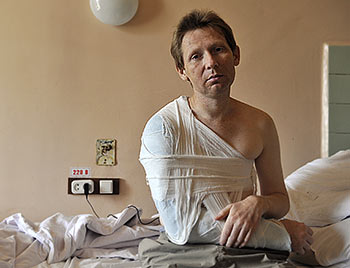
Posting Komentar